Flexible Printed Circuits (FPCs) use high-performance film materials—such as polyimide and liquid crystal polymer (LCP)—that are designed to provide flexibility, thermal stability, and electrical insulation. This page explains these materials and related fundamentals of flexible printed circuits, including key characteristics and typical use cases across industries.
What Is a Flexible PCB (FPC)?
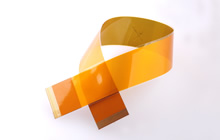
Commonly referred to as FPCs, flexible printed circuits are designed to bend and conform to space constraints while maintaining electrical performance.
Unlike rigid printed circuit boards, FPCs can continue to perform as intended even when bent, with electrical characteristics remaining stable.
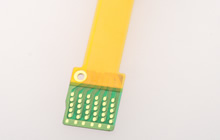
A typical FPC structure is based on a thin insulating base film laminated with an adhesive layer and conductive foil. This construction supports the mechanical durability and thin profile required for modern, high-density electronic assemblies.
Reference: Sanyo's official website (http://www.wsanyo.jp/menu01/)
Applications of Flexible PCBs
Because their electrical characteristics can remain stable when bent, FPCs are commonly used as interconnect cables between circuit boards or between internal units/modules.
In consumer and office products, FPCs are used in devices such as calculators, printer heads, keyboards, LCD monitors, camera lens assemblies, and hinge sections in foldable mobile phones.
They are also widely used in specialized fields such as aerospace and aviation, where weight reduction is a key requirement.
In general, many products for which “being able to bend a circuit without changing electrical characteristics would be useful” are likely candidates for flexible printed circuits.
Reference: Sanyo's official website (http://www.wsanyo.jp/menu01/)
Structure of Flexible PCBs
Flexible PCBs are generally categorized into two primary configurations: single-sided and double-sided.
Single-sided FPCs: This structure prioritizes thinness, flexibility, and low weight, and is commonly used in areas with frequent movement. While its functionality is more limited than that of double-sided structures, it typically offers higher durability under repeated flexing.
Double-sided FPCs: This structure prioritizes functionality and is used for more complex circuits, including crossover routing. Although it enables higher circuit functionality, durability under repeated flexing is generally lower than with single-sided structures.
Substrate materials used in flexible PCBs (FPCs) must meet several key performance requirements:
Flexibility
Durability
Heat resistance
Dimensional stability
Electrical insulation
Chemical resistance
Because the substrate supports the circuit, electrical insulation is also required.
In addition, the material must endure processing steps such as plating and lamination, requiring it to possess heat resistance, dimensional stability, and resistance to chemicals. To meet these demands, materials such as polyimide film, liquid crystal polymer (LCP) film, and PET film are commonly used in FPC manufacturing.
Differences Between Mounting Methods
Polyimide
Polyimide is a thermosetting resin known as one of the most heat-resistant plastics available.With a low coefficient of thermal expansion and excellent electrical insulation, it is the most commonly used material for flexible PCB (FPC) substrates.
Compared with liquid crystal polymer, polyimide is generally more cost-effective, which makes it a common choice for general applications.
Liquid Crystal Polymer (LCP)
Historically, flexible printed circuits (FPCs) have primarily used polyimide film as the substrate material. In recent years, however, LCP film has been increasingly selected when high-frequency performance is required.
LCP offers excellent flexibility, durability, heat resistance, dimensional stability, electrical insulation, and chemical resistance. In addition, it outperforms polyimide in electrical properties and has a much lower moisture absorption and expansion rate.
Because of its high-frequency characteristics, LCP is well suited to high-speed transmission circuits and high-frequency electronic devices, and demand has increased in recent years. It also provides stronger gas-barrier performance than polyimide. However, its main drawback is higher cost.
PET
PET film is known for its low moisture absorption, making it ideal for devices operating in humid or moisture-sensitive environments.When combined with transparent solder resist, the non-circuit areas of the board remain see-through, which is useful in applications requiring visual inspection or transparency.
PET is a cost-effective material, particularly for mass production, and can provide good flexibility and performance at a lower cost than polyimide or LCP. However, its relatively low heat resistance can make it unsuitable for heat-generating circuits or for standard soldering processes.
Summary
Flexible PCBs (FPCs) substrates must satisfy multifaceted performance criteria, which significantly narrows the field of viable material candidates. Because each substrate involves specific technical trade-offs, precise material selection aligned with the intended application is critical to ensuring optimal device performance.
The insulators (base films) that form the base of flexible printed circuits (FPCs) primarily include polyimide film, liquid crystal polymer film, and PET film.
Flexible PCBs are "flexible" PCBs as their name suggests,A major feature is that it can be freely bent by force.The optimal film material is selected according to its application and required properties (such as heat resistance and high-frequency compatibility), as it needs to maintain its electrical characteristics and original performance even when bent.
A.
First and foremost, the biggest characteristic of flexible PCBs isFlexibility and durability that can withstand "bending" are strongly required.Furthermore, high electrical insulation is essential as it serves as the base to hold and protect the conductor foil (circuit).
Furthermore, since various processes such as plating and laminating are applied in the manufacturing process, heat resistance, dimensional stability, and chemical resistance are also required as important properties to withstand these processes.
A.
Polyimide is one of the most heat-resistant plastics among thermosetting resins. Due to its low coefficient of thermal expansion and high electrical insulation properties, it is widely used as a substrate material for flexible printed circuits (FPCs).
Also, compared to liquid crystal polymers (LCPs), for which demand has been increasing in recent years,It has the significant advantage of keeping material costs low.Therefore, it is widely used for general-purpose flexible printed circuit boards.
A.
Liquid Crystal Polymer (LCP) isIt possesses fundamental performance characteristics such as flexibility and heat resistance, while also offering superior electrical properties compared to polyimide and exhibiting a low coefficient of moisture expansion.
Because it has excellent high-frequency characteristics, it is increasingly being adopted in high-speed transmission circuits and the latest electronic devices that require high-frequency compatibility. Furthermore, it also has excellent gas barrier properties, but it also has the disadvantage of being more expensive than polyimide film.
A.
Because PET film has a characteristic of being very resistant to moisture absorption,It is often used for flexible circuit boards of equipment used in environments where humidity becomes critical, or under high humidity conditions.Also, a major advantage is that the cost is low when produced in large quantities, making it highly cost-effective.
On the other hand, compared to polyimides and liquid crystal polymers, its heat resistance is lower, which is a clear disadvantage, making it unusable for circuits that generate heat or in normal soldering processes. Its use is limited to specific applications, such as when visualization is required using transparent resists.
Each company has different motivations for looking for a flexible printed circuit board (FPC) supplier. Here we introduce three FPC manufacturers, each with their own areas of expertise, according to three typical needs.
For high difficulty and special specifications
Sanyo
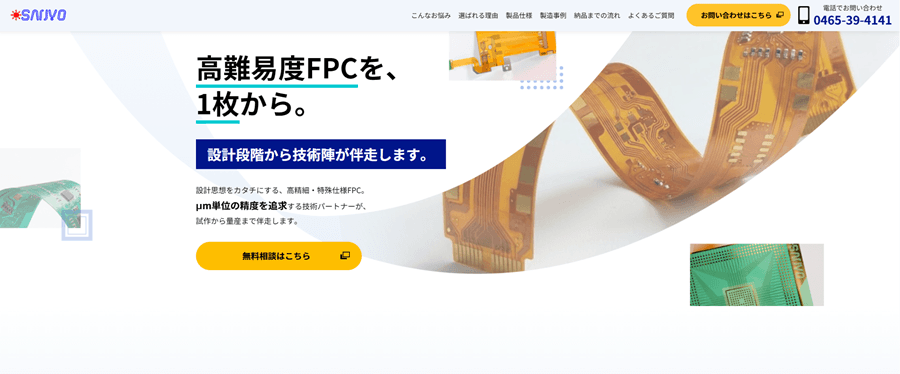
Source: Sanyo Official Website (https://www.landingpage-synergy.com/6Ik8Yr0D/)
Even special specifications rejected by other companies can be discussed with our engineers from the design stage.
Compatible with high-definition boards with a single-sided pitch of 20 µm, enabling equipment miniaturization
Flexible response with in-house integrated production from a single prototype to mass production