What is BVH? A non-through interlayer connection used for high-density FPCs
BVH (Blind Via Hole) is a via used to electrically connect required conductor layers without penetrating the board to the opposite side. In FPC,When you want to take advantage of the structure that opens on only one side to secure space for mounting and wiring on the opposite sideis taken into consideration. However, acceptance is not determined solely by the hole diameter. It is important to design taking into consideration the positional relationship with the connecting layers, opening surface, mounting lands, and bent sections.
BVH is a blind via with an opening on only one side.
BVH stands for Blind Via Hole. In multilayer printed circuit boards, it mainly refers to a non-through hole that connects the conductive pattern of the outer layer to the conductive pattern of the inner layer. The hole is visible from one side, but does not go all the way through to the opposite side.
What matters is the cross-sectional structure rather than the name. Instead of simply writing "BVH" on the drawing, indicating from which side the opening is made and to which layer it connects helps prevent misunderstandings.
Difference from Through-hole and IVH
The difference from through-hole is whether or not the hole penetrates the board. Meanwhile, the level of detail referred to by IVH may not be consistent depending on the documentation or manufacturer. Do not judge by the abbreviation alone; check the cross-sectional view and the connection layers.
How to inspect via structures
Title
Concept of Openings and Connections
What you want to clearly specify in the drawing
through-hole
Penetrate the front and back of the board and connect the necessary conductor layers.
hole diameter, land diameter, connection layer, keep-out zones on both sides for routing
BVH
Opens from one side and connects to a predetermined layer without penetrating to the opposite side
opening side, start layer and end layer, via diameter, land, presence of filling
IVH
It is difficult to uniquely determine the connection range by the name alone.
Cross-section with layer numbers and definitions of terms used by the manufacturer
Advantages of using BVH in FPC
01
Easy to use the opposite side for pads and wiring
To prevent the hole from penetrating all the way through to the opposite side, the same location on the unopened side can sometimes be used as a contact pad or component mounting land. In FPCs where mounting area is limited, this serves as a means to secure wiring flexibility directly beneath components or around terminals.
02
It is possible to connect only the necessary layers.
By connecting only to the required layers instead of penetrating the entire board, it becomes easier to leave wiring areas on other layers. This is an effective approach when you want to fit circuits into the limited area of a multilayer FPC.
03
It becomes an option for thin and high-density structures.
Taiyo Technorex explains that because BVHs can be formed as non-through vias directly on land areas and require only a single layer of copper plating, they are well-suited for miniaturization and high-density conductor routing. However, the final thickness and wiring density are determined by the overall design, including materials, layer construction, and processing conditions.
Typical construction methods and structures of BVH
Even with the same BVH, manufacturing conditions vary depending on how the hole is formed and whether the inside is filled. Rather than just listing terminology, it is important to share the required cross-section with the manufacturer.
Representative names for BVH
Title
Structure and formation method
Verification points
Conformal BVH
Conformal mask method
aperture size, positional accuracy, compatible copper foil and insulating materials
A structure filled with BVH (Blind Via Hole) inside. Depending on the product, it is used for multi-layering and high-density integration.
filling method, top surface flatness, connection configuration with the next layer, inspection method
Skip Beer
Structure illustrated in adoption examples of Japan CMK's ultra-thin multilayer FPC
Check the connecting layers and cross-sectional structure for each product.
The distinction between "conformal" and "direct" is based on Taiyo Technorex's glossary. Since that page explicitly states that it may include unique terms and usages, please confirm with your supplier whether they use the same definitions.
The start and end layers and the opening surfaces will be indicated in the layer configuration diagram. Rather than relying solely on abbreviations, it is certain to reach an agreement using a cross-sectional view.
02
What to use the empty space for
Clarify areas to be secured with BVH, such as component mounting lands, contact pads, and routing traces. Without a clear purpose, it is impossible to determine which via structure is suitable.
03
Transmit the FPC bending conditions at the same time
In addition to the BVH cross-sectional conditions, the drawing must also indicate whether the part is to be statically bent or repeatedly moved, as well as the bending position, radius, and direction during use, and the entire structure must be included in the manufacturer's design review.
04
Will it fit within the manufacturing rules for mass production?
Via diameter, land diameter, insulation layer thickness, alignment, and presence of filling are confirmed under mass-production conditions combining materials and layer configurations. Please inquire separately about prototype limit values and mass-production control values.
05
What to inspect to guarantee continuity and connection quality
We determine electrical inspection, cross-sectional checks, necessary reliability evaluations, and lot management according to the application. If applicable standards exist, we align not only the standard names, but also the revisions and requirement classifications with the supplier.
IPC-2223 is a standard that deals with design requirements for FPCs and rigid-flex boards. For projects that specify standards, please check the current version at the time of ordering and the specific requirements with the manufacturer.
Differences in application of Through-hole, IVH, and BVH
BVH is not for when you want to use new technology, but when you need mounting and wiring areas that cannot be secured with through-holes. You determine the requirements first and choose the simplest structure that satisfies them.
Candidate via structures based on requirements
Requirements
candidate
Items to check at the time of judgment
I want to make an interlayer connection all the way through the board.
through-hole
Can you allow dual-side lands and keep-out zones?
I want to use the opposite side for mounting lands and wiring.
BVH
Can you manufacture the aperture, connection layer, and required via diameter?
Multiple non-through connections including inner layers are required
Interlayer vias including IVH and BVH
Can we agree on the starting and ending layers, as well as the stacking order of each via, using a cross-sectional view rather than just their names?
There is margin in the wiring density, and double-sided openings are permissible.
Compare including through-holes
Area secureable by BVH, and manufacturability and quotation conditions for each structure
Information to provide when consulting an FPC manufacturer
layer configuration diagram, and the start layer, end layer, and opening plane of the BVH
Desired via diameter and land diameter, and the positions of component mounting lands
Electrical conditions such as line width/spacing, current, and impedance
Distinction between static and repeated bending, as well as bending position, radius, and direction
Number of prototypes, planned production volume, desired delivery date, inspection and submission documents
Once we can organize the necessary connection layers and usage conditions, let's compare manufacturers capable of handling high-density FPCs containing BVHs.
Each company has different motivations for looking for a flexible printed circuit board (FPC) supplier. Here we introduce three FPC manufacturers, each with their own areas of expertise, according to three typical needs.
For high difficulty and special specifications
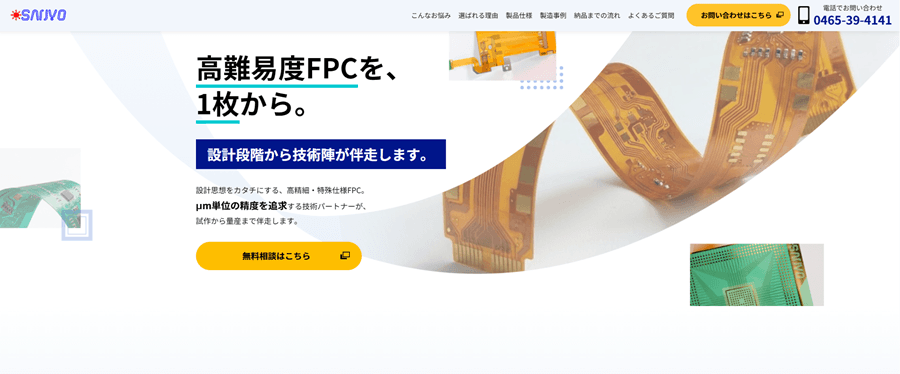
Sanyo
Source: Sanyo Official Website (https://www.landingpage-synergy.com/6Ik8Yr0D/)
Even special specifications rejected by other companies can be discussed with our engineers from the design stage.
Compatible with high-definition boards with a single-sided pitch of 20 µm, enabling equipment miniaturization
Flexible response with in-house integrated production from a single prototype to mass production