How to speed up FPC prototype production in a short lead time?
FPC prototype lead time and order preparation
How to expedite prototype production for FPC in a short turnaround time? From specification confirmation to choosing a partner
The lead time for FPC prototypes varies depending on the layer configuration, material, quantity, and whether components are mounted or not. If you are in a hurry,The day you want to start the evaluation, the required completion status, and specifications that cannot be changedLet’s first communicate the details and confirm the delivery date under those conditions. It’s important not to set a schedule based solely on manufacturing time; rather, it’s essential to consider everything from data verification to implementation, inspection, and transportation.
How long does it take to prototype a FPC? Check the calculation of the delivery time
The number of days required for prototype production for FPC does not have a fixed standard. Even the short lead time information available online has conditions regarding the structure, materials, quantity, and handling of holidays. Please present your own drawings and desired quantities and check the applicable delivery time.
When looking at the "shortest delivery time,"From when to when something is completed?Make sure that the quote request date, order date, and date when production data is finalized are treated as the same starting point.
Starting date: At any point between order acceptance, data verification, and specification approval
Working days: Including Saturdays, Sundays, and public holidays, or factory holidays
Deadline: What time is the submission and approval time for the day-of-event registration and approval?
End point: factory shipment or arrival at designated location
Completed state: Either a bare substrate or a substrate that has been completed with component mounting and inspection.
Determining conditions: What must be met to guarantee a delivery date?
The internal schedule is compiled by subtracting work that remains with the company from the start of the evaluation, such as receiving confirmation and implementing the work. When communicating the desired date of shipment in the completed state that is necessary, in addition to “as soon as possible,” to the ordering party, it becomes easier to determine the response.
Specifications that determine whether the product can be produced in a short lead time
In confirming manufacturability, we go one step further from the “FPC-compatible” classification and provide information about the actual materials and processing conditions. If you are asked to make a change to the specifications, please ask what changes will affect the delivery date.
The ingredients are checked not only by the name but also by the thickness and availability.
We will determine the type of substrate, substrate thickness, type and thickness of copper foil, cover layer, and reinforcement plate. While we have a manufacturing system that stocks standard materials, it does not necessarily mean that we have them in stock. Please check if the specified material composition can be secured in sufficient quantities, or if there are alternative candidates.
Consolidates layers, holes, surface treatments, and reinforcement plates
In addition to single-sided, double-sided, and multi-layer products, we also provide cross-sectional drawings showing inter-layer connections, line width and spacing, surface treatment, and the material, thickness, and position of reinforcement plates. If a cross-sectional drawing includes the reinforcement plate, you can share the requirements for the finished product, such as the finished thickness of the terminal portion.
Forming is asked about whether it is necessary to use a mold and whether it fits with the drawing.
There are also methods of machining the shape with a laser, without using a mold. Before deciding whether to use this method, please check with the client whether it is possible, and consider whether the required external dimensions, tolerances, and slits are met. Do not expect to save time just by using the name of the machining method; please ask about the difference in delivery time and initial costs when using a mold.
When shortening the delivery time, we leave the necessary conditions for evaluation.
Even when prioritizing short lead times, do not change what you want to verify with a prototype. Materials and structures are related to the flexural strength of FPCs, and the thickness of the insulation layer and the wiring dimensions are also related to impedance. When replacing them with a more accessible specification, please make your decision based on the evaluation purpose.
01
We will decide on the basis of this prototype.
The following are the items used to determine the approval or rejection of this design: how well it fits into the enclosure, its connection to connectors, the circuit operation, repeated bending, and transmission characteristics. Even if the initial step is only to check the shape, the design team should decide which dimensions and thicknesses need to be matched to this specification.
02
Consult with specific conditions that can be modified
Instead of just saying "equivalent product acceptable," specify how much of the materials, thickness, surface treatment, and external machining can be changed. Please confirm the changes with the design team and proceed with manufacturing after approval.
03
Review the number needed and the way approvals are processed
We divide the required quantity for the initial evaluation and subsequent quantities, and discuss whether early delivery is possible. Since it is not guaranteed that smaller quantities will always be faster, please check the delivery time and additional costs. We will also determine the person responsible for answering questions regarding the drawings and the approval deadline.
Data to be prepared before quoting and submitting
In the initial consultation, we will separate the confirmed and unconfirmed conditions. The following is a guide to the information to prepare: Please consult with the client regarding the file format and required materials to be accepted.
Desired conditions: Date of shipment request, start date of evaluation, quantity, and whether partial delivery is available
Production data: circuit pattern, hole data, and layer relationships for each layer
Form drawing: Dimensions and tolerances, holes and slits, and shape of terminal parts
Layer configuration: substrate material and type of copper foil; thickness; cover layer; final thickness
Processing specifications: Surface treatment, material, thickness, and position of reinforcement plates, delivery form
Use conditions: Fixed or bent repeatedly; bending position, radius, and direction
Electrical and quality requirements: Required electrical characteristics, inspection items, and records to be submitted
Implementation information: component list, mounting diagram, placement coordinates, availability of component delivery, and expected arrival
If Gerber data is not available yet, clarify whether the request is for manufacturing only or for pattern design. If you want to consult on the design from the start, make sure to review the current materials, such as schematics and external dimensions, to determine what can be determined at this time. We will also quote you a price including the estimated time required for design and verification.
Drawings, specifications, and manufacturing data to be sent will be numbered and kept up to date. If any revisions are made, please specify the changes and the items to be replaced, and let us know if it is necessary to stop manufacturing using the old version.
Create a schedule that includes component mounting and inspection
If you are evaluating a component with a bare board, be sure to separate the completion date of the bare board from the completion date of the mounted component. Decide who is responsible for what part of the process—from board fabrication, component procurement, mounting, and testing and evaluation.
If you are requesting implementation, we will also check the estimated arrival date of the parts, the shortage of supplied components, and the status of the mounting data and fixtures. If you are requesting implementation from another company, please coordinate in advance not only the date of delivery but also the mounting form of the board, such as the mounting position.
Distinguish between inspection during manufacturing and evaluation based on usage
Inspection to verify the appearance and electrical connections, and evaluation to verify bending, heat resistance, and transmission characteristics differ depending on the subject of verification. Please confirm the items included in the quote, the number of items, and the evaluation criteria for each inspection separately.
Rather than deciding that no testing is necessary because of the short turnaround time, the design and quality team will agree on the necessary checks for this prototype. If testing records or evaluation reports are required, include the submission date in the schedule as well.
Compare costs and providers under the same conditions
The comparison is between the delivery date and total cost for the same drawing, quantity, and finished condition. We check not only the board unit price, but also how much of the cost is included for design, initial preparation, processing, mounting, and testing.
Design and initial costs: including pattern design and preparation of manufacturing data
Processing and inspection costs: Whether molds or fixtures are required and whether they are included in the quote
Implementation cost: including parts, mounting work, and necessary preparation costs
Delivery time fee: Whether there are additional costs for rush service, partial delivery, or transportation.
Handling when making changes: Will there be additional costs or delivery delays due to data replacement?
Quality compliance: Are the necessary inspection records and contact and response procedures for malfunctions clearly defined?
When budget is tight, estimate the costs for both the regular schedule and the shortened schedule using the same specifications and quantities, and compare the difference with the additional days required. If you also want to estimate the costs with different quantities or specifications, please record the changes separately.
When choosing a supplier, in addition to answering whether or not they can manufacture the product, we will check the status of securing materials, any uncertainties, and the conditions for determining the delivery date. If there are any changes to specifications or any issues arise, having a clear understanding of who to contact will ensure clear communication after placing the order.
Examples of judgment and consultation when it is not possible to meet the expected date
If a response comes stating that we cannot meet the expected delivery date, we will ask about the time required for material procurement, manufacturing, installation, and testing. Depending on the reason, please discuss changing the inventory materials, delivering the required quantities in advance, or splitting the evaluation.
Neither of these methods is guaranteed to reduce the delivery time. For each proposed change, we will check the delivery date, cost, and items that can be confirmed. If the specifications required for evaluation cannot be maintained, we should not try to determine the success of the prototype, but instead consider changing the evaluation schedule.
When consulting, you can use the following example form to customize it to suit your case.
Once the necessary requirements are organized, we should shortlist manufacturers that meet the structure, processing, and implementation requirements, and proceed with consultation using the same materials.
Find an FPC manufacturer that matches the required specifications and scope of work
Each company has different motivations for looking for a flexible printed circuit board (FPC) supplier. Here we introduce three FPC manufacturers, each with their own areas of expertise, according to three typical needs.
For high difficulty and special specifications
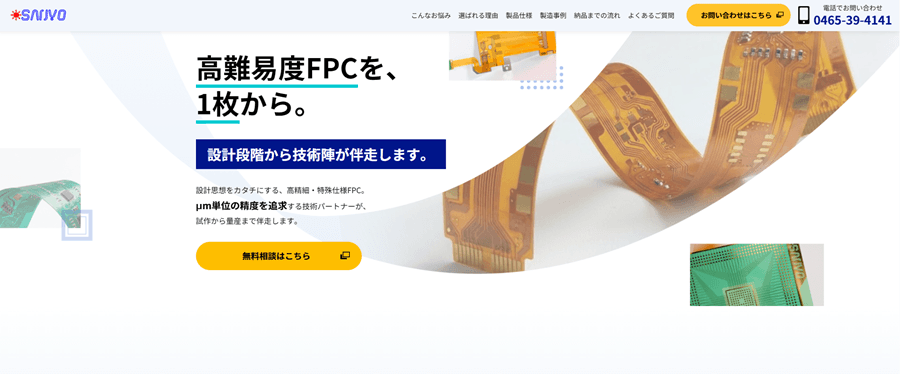
Sanyo
Source: Sanyo Official Website (https://www.landingpage-synergy.com/6Ik8Yr0D/)
Even special specifications rejected by other companies can be discussed with our engineers from the design stage.
Compatible with high-definition boards with a single-sided pitch of 20 µm, enabling equipment miniaturization
Flexible response with in-house integrated production from a single prototype to mass production